
Case:
Ductor's Biogas Plant Reduced Cleaning Downtime by 97%
Struvite fouling controlled. Less cleaning and lower chemical use. Since 2022.
INDUSTRY: BIOGAS | CUSTOMER: DUCTOR | COUNTRY: GERMANY | PROCESS: HIGH-NITROGEN BIOGAS PROCESS
ISSUE
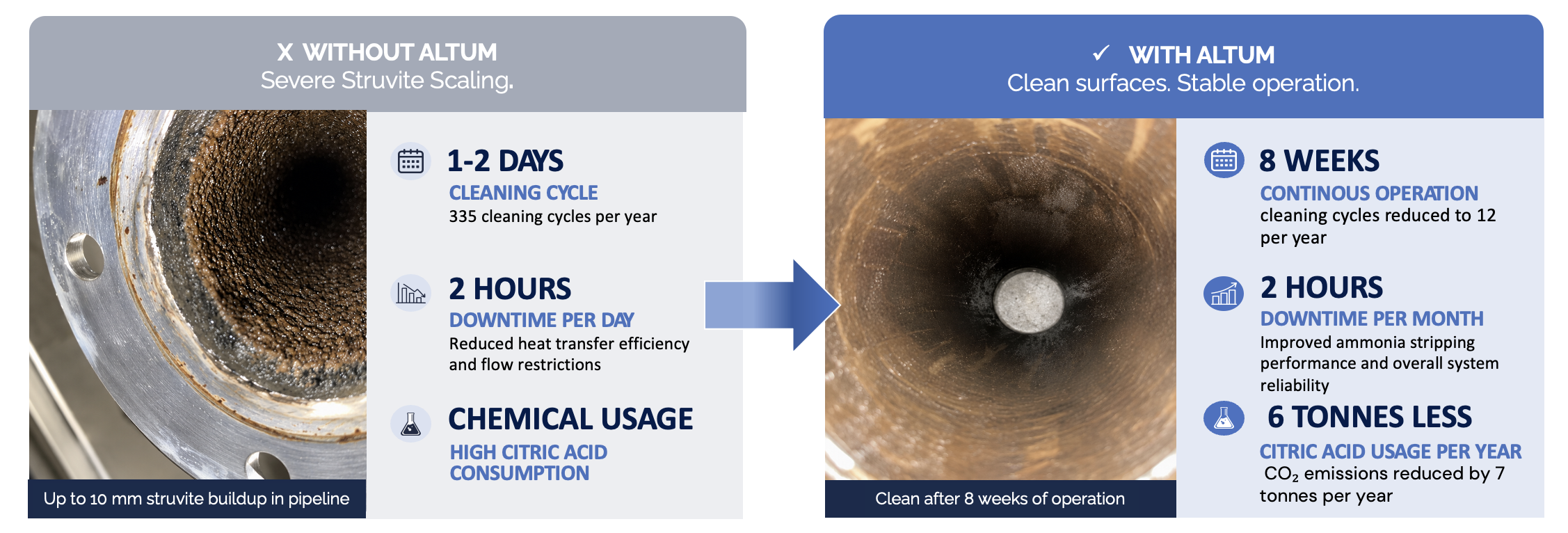
Ductor's German biogas plant processes high-nitrogen feedstocks such as chicken manure through anaerobic digestion, ammonia stripping and nutrient recovery. These conditions are close to ideal for struvite to form. The result was heavy struvite scaling across pipelines, plate heat exchangers and pumps, with deposits up to 10 mm thick. This lowered heat transfer efficiency and caused rising pressure losses and flow restrictions.
To keep the plant running, the team relied on near-daily clean-in-place cycles: cleaning every one to two days, around two hours of downtime per cycle, and roughly 335 cleaning events per year, together with heavy citric acid consumption. The process was stuck in a continuous loop of fouling, cleaning, chemical handling and manual labour.
SOLUTION
Rather than removing deposits after they formed, Altum's approach targets how particles form and behave in the liquid. High-power ultrasound was installed externally on the pipelines upstream of the critical heat exchange equipment, with no process modifications and no production interruption. The ultrasonic field keeps solids suspended in the flow instead of letting them attach to surfaces, so hard deposits no longer build up on the heat exchangers and pipelines.
RESULTS
- Cleaning cycle extended from 1 to 2 days to 8 weeks of continuous operation
- Annual cleaning cycles reduced from 335 to 12, a 97% reduction
- Downtime down from around two hours per day to two hours per month
- Citric acid consumption reduced by more than 6 tonnes per year
- CO₂ emissions reduced by more than 7 tonnes per year
- Improved ammonia stripping performance and overall system reliability
After several weeks of operation, the previously fouled pipelines stayed largely clean with only minimal residue.
Value drivers: less downtime and a more stable process, lower operating costs, lower emissions, and non-invasive clamp-on deployment with no process modification.
For the full story, including how struvite forms in biogas processes and where the highest risk lies, read our in-depth article on the Ductor case.